Systems Thinkers in STEM Ambassadorship
2026-2027 Systems Thinkers in STEM Ambassadorship (STiSA)
This year’s application window is now CLOSED. Next year’s application will re-open in mid-January 2027.
Current Ambassadors – continue to reach out as you apply what you learned in your STiSA micro-course to your projects. Message us on Slack (preferred) or email if you have any questions and/or need anything from us. We’re ready to help! Many students have formed teams and are working and communicating in Slack channels. Feel free to do the same!
Future Ambassadors, read below to learn more about this year’s STiSA program and come back to this page in the future for real-time updates.
Current 10th and 11th graders were eligible to apply for STiSA. All applicants who completed the full application were accepted into STiSA and can choose whether or not to participate. You can participate in both STiSA and an internship or DREAM-High, should you be selected.
We are in the midst of hosting numerous online micro-courses, workgroups, and in-person events – all for free! Ambassadors can participate according to their interest and time, beginning as early as mid-June and beyond. We will have events with ISB’s scientists, educators and even Nobel Laureate Dr. Mary Brunkow. Most meetings will happen online, but there will be some in-person opportunities for those who are in the local area. Please also keep an eye on this program page, as we’ll be updating the page and calendar with offerings! See this calendar, which we update daily, with new opportunities. You’ll need to sign up for each offering through the Slack channel and/or forms that have been shared.
As a participant, your first step was to complete the form you received via email. That form contained information about joining our interactive Slack channel and receiving more information. Slack allows you to stay connected with our team and each other to hear about upcoming opportunities to advance your systems thinking in STEM. You’ve been invited to various channels depending on your interests – so please make sure to read all notifications on any channel you’re a part of. The Slack channels provide opportunities to learn more about STEM systems, to collaborate on projects, and to build connections with peers and ISB staff. The SEE team will regularly use Slack to share STEM-related opportunities at ISB, at the numerous partner organizations in our network, and projects you can lead in your community. As we get to know you, we will add even more micro-courses and events based on YOUR interests! In the meantime, learn more about the course progression and read the individual course descriptions below:
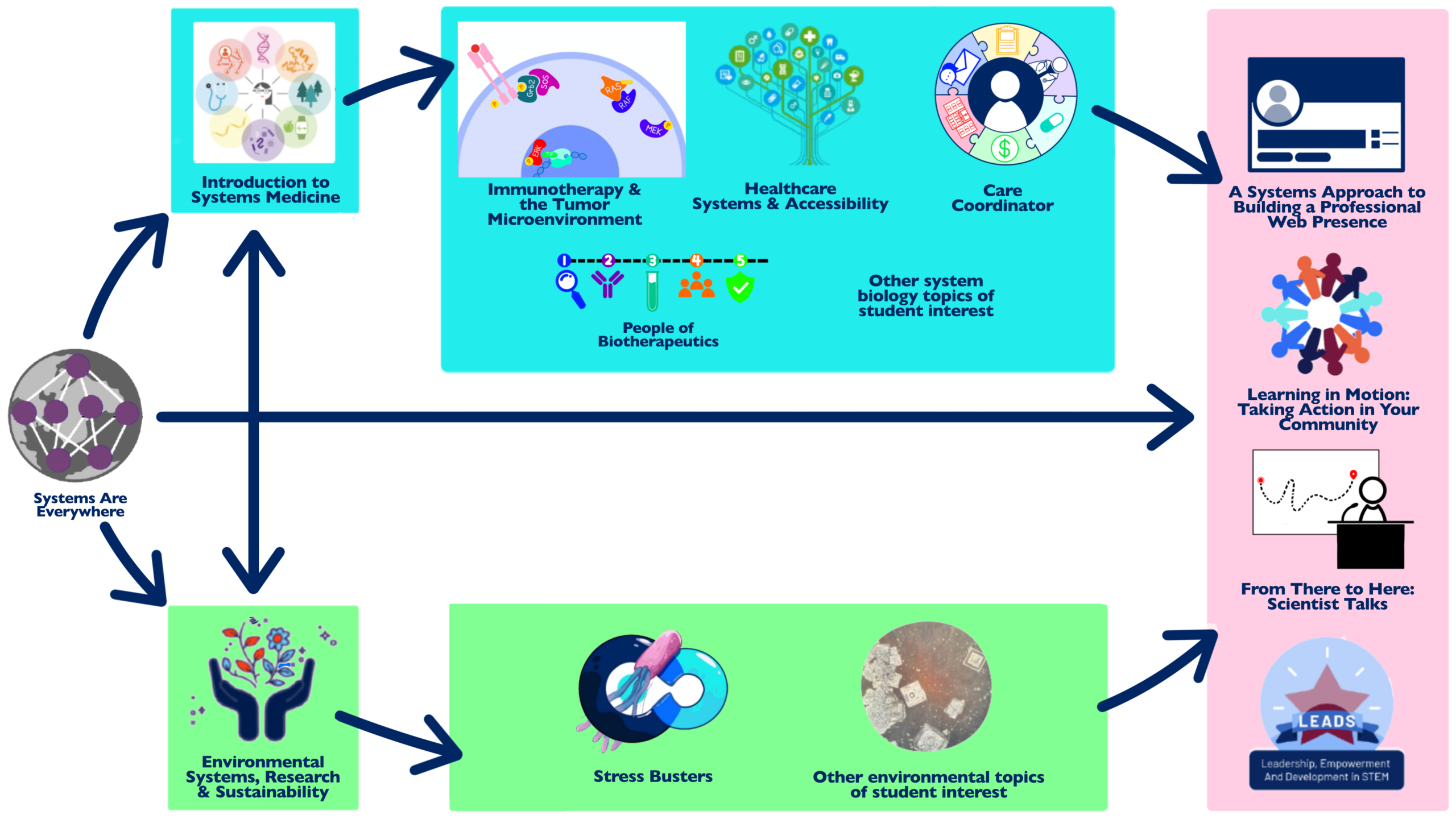
Systems Are Everywhere – This 2-hour workshop will prepare attendees to become a systems thinker in STEM. During the workshop, participants will:
- Learn what systems are
- Use an online modeling tool to create and modify a systems model
- Learn about systems thinking skills and why they are important
- Explore how systems thinking is used by STEM professionals.
- Build 21-st century learning skills, gain knowledge of STEM careers, pathways, and workplaces, and strengthen STEM identity and aspirations.
Agenda Overview:
| 10 minutes | Opening & Introductions |
| 40 minutes | LEARN about systems and models |
| 5 minutes | Break |
| 30 minutes | DEVELOP systems thinking skills |
| 30 minutes | APPLY your knowledge & skills to a complex problem |
| 5 minutes | Next steps: YOU can become a systems thinker in STEM |
Micro-courses descriptions:
- Introduction to Systems Medicine – Students will be introduced to the concept of systems medicine (medicine that is predictive, preventative, personalized and participatory), and how researchers and physicians alike can use this perspective to understand the human body as a complex network of networks.
- Environmental Systems, Research, and Sustainability: Students will complete a survey to gauge their interest in various environmental topics, such as, Ocean Acidification, Modeling Sustainable Food Sources, Invisible Forest, Bioengineering a Sustainable World and Carbon’s Fate. With this information students will be able to attend an additional workshop that is environmentally based and related to their interest.
- Once students have taken this, they have an opportunity to complete an in-person experience. We’ll coordinate a time where students can come to ISB to learn about one of our favorite model organisms and play a card game that tests the limits of that organism. You’ll take on the role of that organism and see if you can survive despite all life throws your way.
- Learning in Motion: Taking Action in Your Community – This micro-course is designed to inspire students to become active participants in their local communities. Students will explore how to identify needs and opportunities within their target community, how to develop a vision and goals for an action project, and review best practices for identifying and engaging with key stakeholders. After the workshop, students will be invited to remain connected with the SEE team and be mentored on their own individual project, which will eventually be showcased on our Featured Student Projects page.
- Other Systems Medicine Topics per Student’s Interests
- Once students have taken Introduction to Systems Medicine they have the opportunity to dive deeper into the topics of personalized medicine and healthcare systems. At this time, there are three ways we can do this.
- One option is through a new course called Understanding Healthcare Systems to Improve Accessibility. This interactive course will help you understand healthcare systems in the US and other countries so that you can take action on ensuring you and those you love get access to care.
- A second option is through the lens of immunotherapy. Immunotherapy and the Tumor Microenvironment is a 1-hour online course that introduces students to the basics of using Python. No prior coding experience is required.
- A third option is an opportunity to join us as an author! The People of Biotherapeutics is an interactive workgroup that will ultimately create a career-connected activity for our Personalizing Disease Treatments module within our 180-hour Systems Medicine course. This passionate group of ambassadors will create an interactive website that houses interviews and career profiles of all of the people it takes to move from discovering life-saving biotherapeutics to getting them into the hands of patients at scale.
- A fourth option is an in-person opportunity to run through a case study simulation that models what it’s like to coordinate someone’s care while they are in the midst of a health crisis.
- Once students have taken Introduction to Systems Medicine they have the opportunity to dive deeper into the topics of personalized medicine and healthcare systems. At this time, there are three ways we can do this.
- Leadership Empowerment and Development in STEM (LEADS) – After completing Systems Are Everywhere, students will be invited to join a future cohort of LEADS. This program helps students build 7 major skills that are foundational to STEM leaders. See this page to learn more.
- A Systems Approach to a Professional Web Presence – Students will build on their systems thinking skills to learn about professional communication techniques and will begin to create a professional web presence and network that highlights their STEM skills and interests.
- From There to Here: Scientists’ Talks – We’ll be scheduling and posting various talks by scientists so that ambassadors can learn more about the circuitous routes many take in the journey from being a student to a STEM Professional! One of many talks will be from ISB’s Dr. Mary Brunkow, a 2026 Nobel Laureate.
If you are interested in learning more about previous years’ STISA programs, view our Archived STISA Program Page and our Featured Student Projects page to learn more.
Thank you to our current sponsors! If you are interested in supporting and/or sponsoring this program, please visit https://give.isbscience.org/STEM-education. Thank you!